



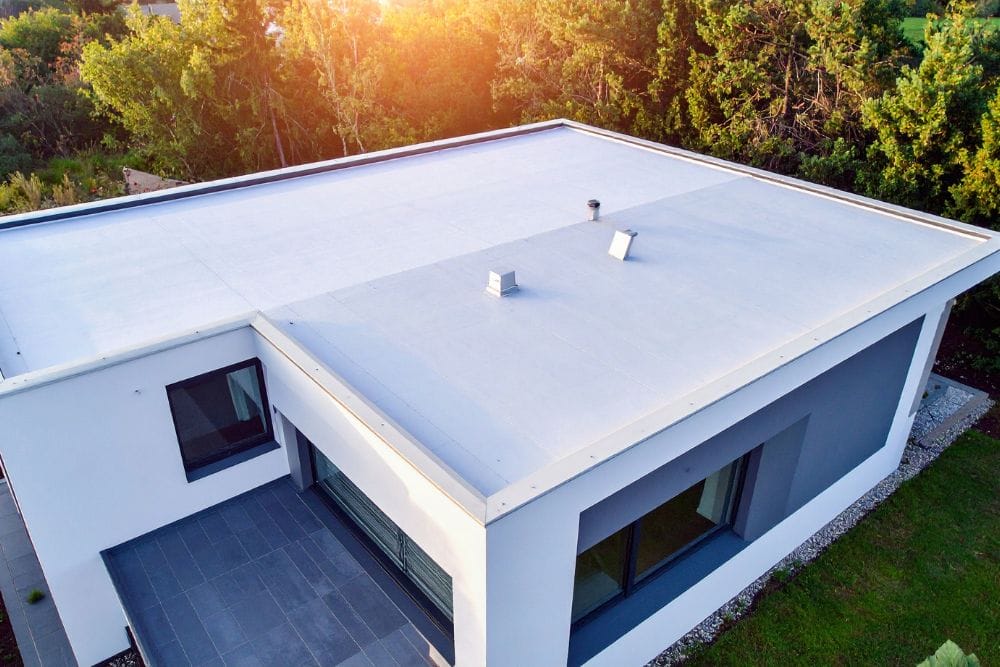
Flat roof leaks are notoriously difficult to locate. On a sloped shingle roof, water enters at a point on the surface and may travel along the roof assembly before reaching the ceiling below. On a flat roof, water that breaches the membrane can travel horizontally for several feet, or even meters, before finding a path downward through the roof assembly. The stain you see on your ceiling may not correspond closely to where the actual leak is on the roof surface above.
This characteristic makes flat roof leak detection a genuine skill, not just a matter of looking for the obvious wet spot. Commercial buildings, garage roofs, low-slope additions, and rooftop terraces throughout the Gatineau-Ottawa area share this challenge, and addressing it requires a systematic approach rather than guesswork.
This guide explains the specific characteristics of flat roof leaks, the detection methods available to property owners and contractors, and the decision points that determine when professional diagnostic tools are the most cost-effective option.
Key Points on Flat Roof Leak Detection
These fundamentals shape every approach to finding a flat roof leak:
- Water travels horizontally under the roofing membrane before finding a downward path, meaning the visible stain and the actual leak source are rarely in the same location.
- Flat roofs are divided into drainage zones, and understanding which zone feeds the stained area narrows the search significantly.
- Membrane penetrations, perimeter flashings, and drainage points are among the more common leak sources on flat roofs.
- Thermal imaging can help detect trapped moisture within the roof assembly that may not be visible from the surface, sometimes identifying sources that visual inspection alone may miss.
- On flat roofs, water entry can escalate considerably from autumn through spring, when freeze-thaw cycles stress the membrane and drainage systems.
- A leak source that is not properly repaired may reappear, which is why accurate diagnosis is more valuable than quick patching.
Why Flat Roofs Leak Differently Than Sloped Roofs
The Physics of Water Movement on a Flat Surface
A flat roof is not truly flat. It is built with a slight slope, typically one-quarter inch of fall per foot of horizontal run, to direct water toward drains or scuppers. This slope is subtle enough that water moves slowly, lingering on the surface longer than on a pitched roof and applying sustained pressure on the membrane below.
When the membrane develops a small opening, water enters and immediately begins moving along the path of least resistance within the roof assembly. This path is determined by the slope of the structural deck, which may be different from the slope of the finished membrane surface above it. Water follows the slope of whatever surface it is on, moving under the insulation layers, along vapor barriers, and between components before reaching the interior of the building.
This horizontal movement, which can carry water many feet from the entry point, is the core reason why flat roof leak detection requires methods beyond simple visual inspection.
Common Flat Roof Systems in Quebec
Different membrane systems present different failure patterns and require different detection approaches. The three systems most commonly found in Quebec and Ontario are modified bitumen, EPDM rubber, and PVC or TPO single-ply membranes.
Modified bitumen, installed with a torch-applied or self-adhesive system, commonly develops problems at seams, at the termination bars where the membrane ends at a wall or parapet, and around penetration flashings. The seams between sheets are common potential failure points, particularly if the original installation did not achieve sufficient heat fusion or if movement over time has opened the joint.
EPDM membranes fail at the seam tape that joins sheets together, at pipe flashings, and at the edge of the membrane where it is mechanically fastened. EPDM is durable in cold conditions but requires the correct primer and tape for field repairs.
PVC and TPO membranes are heat-welded at seams, and failures typically occur where the weld did not achieve full bond, at termination flashings, or at punctures from debris or foot traffic. These membranes can also degrade from UV exposure over time.
Visual Inspection Methods
Mapping the Roof and Identifying Drain Zones
Before climbing on the roof, look at the building plan if one is available, or sketch the roof layout from the ground to identify where drains, scuppers, or interior downspouts are located. These drainage points define the zones of the roof, and water on the ceiling below a specific area of the building likely entered somewhere in the drainage zone above it, though lateral water travel means the actual entry point may be outside that zone.
This narrows the inspection area considerably, particularly on large commercial flat roofs where a comprehensive surface inspection would otherwise take hours.
Inspecting High-Risk Areas First
Once on the roof surface, prioritize these areas, as they are common sources of failure on flat roofs:
Penetration flashings: Every pipe, vent, HVAC unit, and conduit that passes through the roof membrane is a potential entry point. The flashing collar around each penetration should be fully adhered, without gaps, cracks, or lifted edges. Check the sealant bead at the top of each collar and the bond of the membrane where it meets the base of the flashing.
Perimeter and parapet wall flashings: The transition between the horizontal roof membrane and the vertical wall surface is one of the most common leak sources on commercial flat roofs. A membrane that terminates against a wall should be secured with a termination bar and sealed at the top edge. Look for lifted sections, gaps in the sealant line, and rust at the termination bar fasteners.
Drain and scupper areas: Drains should be fully embedded in the membrane with no gaps around the drain body. Scuppers should have continuous membrane coverage extending up the sides. Check that drains are clear and functioning, as standing water accelerates membrane deterioration in the drainage zone.
Seams and laps: Run your hand along the seams between membrane sheets, feeling for any edge that lifts or separates. On modified bitumen, look for seams that appear unfused or that show bubbling, which may indicate that moisture was present at the time of installation or has since entered. On single-ply systems, seams that have not achieved full heat-weld penetration may peel back under sustained water pressure.
Flood Testing for Defined Roof Sections
Flood testing, also called ponding or water testing, is generally performed by a professional. It involves blocking the drains in a defined roof section and introducing a measured depth of water, then monitoring for interior water entry after a set period. This method can help determine whether a leak exists in that section and narrow the search area, though it should only be performed on a roof confirmed to be in adequate structural condition, as the added water load can create structural and interior-damage risks. It also requires careful coordination between the person monitoring the roof surface and those checking for water entry below. Any active leak point identified this way must be marked precisely before the water is drained.
Advanced Detection: Thermal Imaging
How Thermal Imaging Finds Hidden Moisture
Thermal imaging, or infrared thermography, detects temperature differences on the roof surface. Moisture trapped within the roof assembly holds heat longer than dry insulation as the surface cools after sunset. A thermal camera captures this differential as a visible pattern, with wet areas appearing warmer than surrounding dry sections in a post-sunset scan.
This method can identify trapped moisture within the assembly that is not visible to the naked eye and that other methods may not locate. Thermal imaging can provide a picture of moisture distribution across the roof surface, helping guide repairs toward the affected zone. Results should be interpreted alongside other inspection findings by an experienced operator.
The accuracy of thermal imaging depends significantly on conditions. A clear evening after a warm day often provides clearer results. Heavy cloud cover, recent rainfall on the membrane surface, or strong wind all reduce the contrast that makes wet areas visible. An experienced operator knows how to interpret the results in variable conditions and can distinguish wet insulation from other temperature anomalies like HVAC exhaust or building mechanical systems.
Morin Toitures offers thermography inspection services specifically for this application, providing a documented moisture map that guides targeted repairs and establishes a baseline for future comparisons.
Electronic Leak Detection
Electronic leak detection methods, including high-voltage spark testing and low-voltage vector mapping, identify breaches in the membrane by measuring electrical conductivity. Water conducts electricity; a dry, intact membrane does not. These systems can help locate membrane defects, though their suitability depends on roof-assembly compatibility and conditions. They are particularly useful when visual inspection and thermal imaging are inconclusive.
High-voltage spark testing runs a probe across the dry membrane surface and identifies any point where electrical current passes through to the wet deck below. This method works only on dry membrane surfaces and is most commonly used as a quality control check during new installation. Low-voltage vector mapping can be used on wet roofs and involves placing electrodes at the drain outlets and measuring the current flow pattern across the surface, which reveals breach locations mathematically.
Diagnosing the Root Cause, Not Just the Symptom
Finding where water enters the roof is the first diagnostic step. Understanding why it entered is equally important for a repair that lasts. A membrane failure at a seam may indicate incomplete adhesion, incompatible materials, or movement over time. A penetration flashing failure may indicate that the flashing system used was not rated for the thermal movement experienced at that location. A termination bar failure at a parapet may indicate that inadequate fastening allowed the membrane to pull away under wind load.
If your commercial flat roof is experiencing recurring leaks at the same locations despite previous repairs, the root cause may be a system-level issue rather than an isolated defect. A thorough commercial roofing assessment evaluates the entire installation, not just the most recent failure point.
For buildings that have experienced multiple leak events, establishing a regular inspection schedule can be a cost-effective approach to roof management. Identifying and sealing small membrane defects before they progress may help extend the interval between major restoration work.
When to Schedule a Professional Leak Detection
Hire a professional roof inspector when the leak source cannot be identified through visual inspection, when previous repairs have not stopped the water entry, when the building is large enough that systematic surface inspection would be impractical, or when the roof assembly includes multiple layers that obscure the likely water path.
A professional inspection backed by thermal imaging produces documentation that is useful for insurance purposes, for conversations with contractors about repair scope, and as a baseline record for future inspections. If you are purchasing a building with a flat roof, a pre-purchase infrared inspection is one approach to assessing the moisture condition of the roof assembly, and should be interpreted alongside other inspection findings.
To schedule a leak detection inspection or discuss recurring water entry on a commercial or residential flat roof, contact the team for a consultation.
Conclusion
Finding a flat roof leak accurately is a methodical process that rewards systematic thinking over quick guesses. Understanding how water moves under the membrane, knowing which areas of a flat roof fail most often, and using the right diagnostic tool for the specific situation all contribute to identifying the real source rather than just the most visible symptom. For property owners in the Gatineau-Ottawa area managing commercial buildings, multi-unit residential roofs, or flat-roofed additions, investing in proper detection before committing to repairs can reduce unnecessary repair costs and disruption over the life of the roof.
Frequently Asked Questions About Flat Roof Leaks
Why is the leak stain on my ceiling so far from where water actually enters?
On flat roofs, water that penetrates the membrane moves horizontally through the roof assembly following the slope of the structural deck. It can travel several feet before finding a path downward. This is common in flat roof construction and is why thermal imaging is often a useful detection method when conditions are appropriate.
How do I find a flat roof leak myself?
Start by mapping the roof’s drainage zones relative to the stain location. On the roof surface, inspect all penetration flashings, perimeter edges, seams, and drainage points in the zone above the stain. Feel for lifted membrane edges and probe any area that appears discolored or bubbled. For leaks that resist visual inspection, a professional thermal scan may be an appropriate next step.
Can a flat roof be repaired rather than replaced?
In many cases, yes. Individual membrane defects, failed seams, and deteriorated flashings may be repairable if the surrounding material is in sound condition. When moisture has saturated a large portion of the insulation, or when the membrane is aged beyond reliable repair, a full replacement or a re-cover system becomes the more practical solution.
How often should a flat roof be inspected?
A common professional recommendation is at least twice a year, in spring and fall, though the appropriate frequency depends on the roof’s age, condition, and prior history. In the Gatineau-Ottawa area, the spring inspection should follow the snowmelt and freeze-thaw season to catch any damage accumulated over winter. The fall inspection prepares the roof for the coming cold season by identifying and sealing any vulnerabilities before freeze events make repairs more difficult.