


Choosing a roofer in Ottawa-Gatineau involves more than accepting the lowest estimate. Your roof protects the structure, insulation, and occupied spaces below it. An incorrect diagnosis, poorly detailed flashing, or inadequate ventilation may create problems that only become visible long after the crew leaves.
The most effective way to compare roofing contractors is to apply the same criteria to each one. Confirm the business first, then evaluate its experience with your roof type, the quality of its inspection, and the clarity of its proposal. This guide focuses on selecting a contractor before hiring. For contract terms and payment details, see Morin’s guide to questions to ask before signing a roofing contract.
Key Takeaways
- Confirm licensing, insurance, relevant experience, and references before comparing prices.
- Compare the complete scope, materials, and follow-up service rather than the total at the bottom of each estimate.
Roofer Selection Checklist for Ottawa-Gatineau
| Item to verify | What to request | A reassuring sign |
| Business credentials | Applicable Quebec or Ontario documentation | Current information that matches the quoting company |
| Insurance | Proof of active commercial liability coverage | A recent certificate in the company’s legal name |
| Experience | Projects comparable to your roof | Specific examples and verifiable references |
| Inspection | Review of covering, substrate, flashing, and drainage | Clear findings supported by observations |
| Estimate | Scope, products, quantities, exclusions, and cleanup | Detailed language without vague allowances |
| Work crew | Employees, subcontractors, and site supervision | Responsibilities identified before work starts |
| Warranty | Materials, workmanship, and claim procedure | Written terms that are easy to understand |
| Follow-up | Maintenance, repairs, and a contact person | Clearly defined service after completion |
1. Verify the Business and Its Credentials
For a project in Gatineau, ask for the contractor’s Quebec license number and confirm it through the Régie du bâtiment du Québec contractor registry. The legal name, license status, and appropriate subclasses should match the business providing the estimate.
For work in Ottawa, ask which Ontario registrations and requirements apply to the project. Commercial property owners and other principals may also need to review workplace insurance documentation. The WSIB clearance service can confirm whether a registered contractor’s account is in good standing when a clearance is required.
Check the company address, contact details, and legal name on every document. An established roofer should be able to explain who will sign the contract, supervise the work, and answer questions. Unexplained business names, incomplete contact information, or pressure to commit immediately are reasons to pause.
Morin Insulation & Roofing has served the region since 1982. The company’s About Us page outlines its experience, approach, insurance, and the types of buildings it serves.
2. Confirm Insurance and Safety Practices
Request current proof of commercial liability insurance and make sure the certificate belongs to the company you intend to hire. Roofing involves fall hazards, property exposure, and moving materials. Safety planning should never be treated as a minor administrative detail.
Ask practical questions. Who installs the protective barriers? How are access points controlled? How will materials be secured in high wind? On an occupied property, ask how entrances, vehicles, tenants, employees, and normal operations will be protected.
A roofer should be able to describe its safety process without dismissing your concerns. The answer does not need to reveal internal manuals, but it should show that the risks of your specific site have been considered.
3. Look for Experience With Your Roof System
A contractor who installs residential shingles every day may not have the same experience with a TPO membrane, standing-seam metal roof, or institutional building containing several rooftop units. Ask for recent examples that are genuinely comparable in material, size, slope, and complexity.
Invite the contractor to explain the critical details of the proposed system. For pitched roofs, these may include valleys, eave protection, ventilation, and flashing. On a flat roof, the conversation should include drains, membrane upstands, parapets, penetrations, and traffic around mechanical equipment.
Review Morin’s completed roofing projects for examples of commercial, industrial, institutional, and residential work in the National Capital Region.
4. Assess the Quality of the Initial Inspection
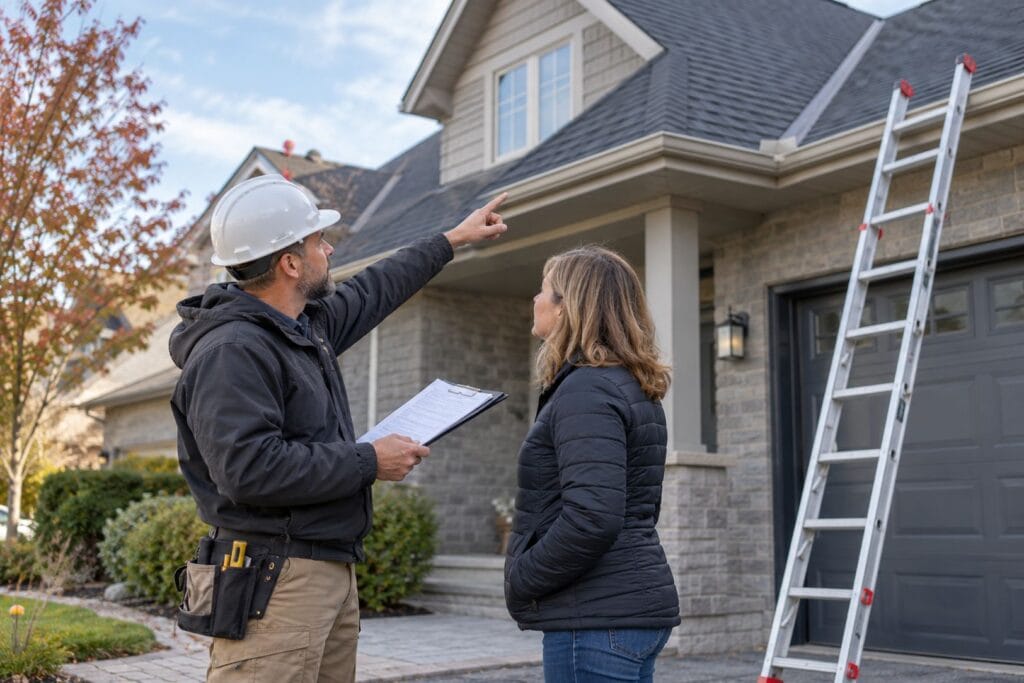
A useful estimate starts with a careful inspection. The roofer should investigate the source of a problem rather than looking only at the point where water appears indoors. Moisture can travel through a roof assembly before it becomes visible.
Ask what was inspected and which areas were inaccessible. The contractor should separate confirmed observations from assumptions. If concealed damage may be discovered after removing the roof covering, the proposal should explain how that damage will be documented, priced, and authorized.
A very quick visit followed by an absolute diagnosis should prompt more questions. A careful contractor can explain why a repair is enough, why replacement is justified, or why additional testing is needed.
5. Compare Equivalent Roofing Estimates
Two estimates may have different totals because they do not include the same work. Check removal of the existing roof, building protection, substrate repairs, insulation, underlayment, flashing, vents, drains, cleanup, and waste disposal.
Products should be identified precisely enough to compare. Terms such as “white membrane” or “quality shingle” do not specify a manufacturer, product line, thickness, performance class, or compatible accessories. Ask which conditions could change the price and how additional work will be approved.
The lowest estimate may be a valid choice if its scope is complete and the contractor is qualified. It becomes risky when the savings depend on unclear exclusions, unspecified products, or omitted protective details.
6. Understand the Warranties Without Relying on Slogans
A roofing project may include a material warranty and a separate workmanship warranty. Ask who administers each warranty, what it covers, its duration, exclusions, and the claim process. Some manufacturer warranties depend on compatible components and installation that follows product instructions.
Do not treat the word “warranty” as unlimited protection. Damage caused by outside events, neglected maintenance, or later work by another contractor may be excluded. Read the written documents instead of relying on a verbal summary.
7. Review Communication and Site Organization
Communication before the project often previews how the work will be managed. You should know who your main contact will be, how changes will be discussed, and when progress updates will be provided.
Ask how the company will protect the property, coordinate deliveries, remove debris, and complete the final inspection. On a commercial or institutional building, planning should also account for operating hours, public access, and rooftop equipment.
Clear communication does not require an unrealistic promise. Exterior work depends on weather and on conditions discovered after the roof is opened. What matters is having a defined decision-making process.
8. Request References From Comparable Projects
Online reviews can provide context, but they are not a substitute for relevant references. Ask for a recent project of the same type and, if possible, an older project that demonstrates how the contractor handles follow-up after completion.
When speaking with a reference, ask whether the schedule and budget were explained clearly, whether the site remained orderly, and whether the company responded after the work was finished. A useful reference addresses the entire process, not only the appearance of the new roof.
9. Check What Happens After the Project
Even a properly installed roof benefits from inspection and maintenance. Ask whether the contractor remains available, offers preventive maintenance, and has a process for urgent calls. A file containing product details, photographs, warranties, and inspection reports will make future service easier.
Morin provides roof repair and maintenance services, including preventive inspections and emergency response. This continuity can be especially valuable for commercial, industrial, and institutional properties.
Roofing Contractor Red Flags
Be cautious when a contractor will not provide credentials or proof of insurance, demands an immediate decision, offers only a verbal price, or refuses to identify materials. Absolute diagnoses made without an inspection, warranties that cannot be supplied in writing, and payment demands that do not reflect work progress also deserve scrutiny.
One concern does not automatically prove that a business is unsuitable. Several inconsistencies or an unwillingness to answer reasonable questions are good reasons to speak with another roofer.
Choose an Ottawa-Gatineau Roofer With Confidence
The right roofer understands the building, documents the assessment, and proposes a clearly defined solution. Take time to verify the company, compare equivalent scopes, and ask as many questions about installation details as you do about price.
Morin Insulation & Roofing has completed projects throughout Gatineau and Ottawa since 1982. To arrange a roof inspection and receive a proposal based on your building, contact the Morin team.
Frequently Asked Questions About Choosing a Roofer
How do I verify a roofing contractor in Quebec?
Ask for the contractor’s license number and search the official RBQ registry. Confirm the legal name, active status, and subclasses relevant to the proposed work.
How many roofing estimates should I get?
Obtaining more than one proposal is often useful, but comparison quality matters more than a fixed number. Make sure each contractor is pricing the same scope and identifying the essential components.
Should I always choose the lowest roofing quote?
No. Evaluate price together with materials, preparation, site protection, warranty terms, and follow-up. A lower quote is worthwhile only when it genuinely covers the same work.
What should I ask during a roof inspection?
Ask about the likely cause, the areas inspected, recommended work, available alternatives, and concealed conditions that could change the scope.
What is the difference between choosing a roofer and reviewing the contract?
Choosing a roofer means evaluating the company, qualifications, insurance, and work process. Contract review is the next step, when the scope, price, materials, payment terms, and responsibilities are confirmed in writing.