



Ontario winters place demands on roofs that homeowners in milder climates may encounter less often. Heavy snowfall accumulates quickly, and wet, dense snow can add significant structural load before most people think to act. Add to that the province’s frequent freeze-thaw cycles and the heat loss through inadequately insulated attic spaces that can contribute to ice-dam formation, and roof snow removal becomes a genuine safety and maintenance concern rather than a seasonal inconvenience.
The challenge is that removing snow from a roof improperly can create its own set of risks, both to the person doing the work and to the roofing material itself. Climbing onto a snow-covered roof is highly dangerous in many circumstances. Using the wrong tools can gouge shingles, puncture membranes, or crack brittle asphalt that has been hardened by the cold. This guide covers when snow removal is actually necessary, how to do it safely from the ground when possible, and when to bring in a professional.
Key Points on Roof Snow Removal
These points establish the baseline understanding needed before undertaking any snow removal work:
- Wet, dense snow can be significantly heavier than dry powder, and repeated accumulation without an intervening thaw can place roofs under considerable load.
- Flat and low-slope roofs tend to accumulate more snow than steeply pitched roofs, where gravity helps shed accumulation naturally.
- Ice dams, not snow weight alone, are a common cause of winter water infiltration in residential roofing.
- A roof rake with an extension handle can provide a safer way to remove snow from the lower sections of single-story and some two-story homes without ladder or roof access.
- Walking on a snow-covered or ice-covered roof surface carries serious fall risk and should be avoided by untrained individuals.
- Roof snow removal is not necessary after every storm; knowing the threshold for when to act can help prevent unnecessary wear on roofing material.
Why Roof Snow Removal Matters
Structural Load and Snow Density
Fresh, dry powder snow weighs roughly 3 pounds per cubic foot. Wet, heavy snow can weigh 20 pounds per cubic foot or more. A flat roof with 18 inches of heavy wet snow across its surface can be carrying a load that approaches or exceeds the design capacity of the structure. While most residential buildings are engineered with safety margins that account for typical snowfalls, unusual accumulation from multiple storms without an intervening thaw period can push total loads into concerning territory.
Flat roofs and low-slope commercial roofs are the primary concern. Pitched residential roofs shed a meaningful portion of snow naturally through gravity, particularly when surface temperatures are slightly above freezing. The same storm that requires attention on a flat garage roof may not require any action on the steeply sloped main roof of the adjacent house.
The Ice Dam Problem
Ice dams are a separate issue from snow weight and arguably cause more damage. They form when heat escaping from a warm living space warms the upper sections of the roof, melting snow at the ridge. That meltwater flows down the slope and refreezes when it reaches the cold overhang at the eave, where there is no warm interior below it. Over time, the ice buildup creates a dam that prevents meltwater from draining off the roof, forcing it to back up under the shingles and into the house.
Ice dams can form even with relatively modest snowfall if attic insulation is poor or if air sealing is inadequate. Improving attic air sealing, insulation, and ventilation can address common underlying causes of recurring ice dams by reducing the heat loss that drives uneven roof-surface temperatures. Snow removal from the lower sections of the roof reduces the material available to form dams during freeze-thaw events, but it is a management tool, not a permanent solution.
When to Remove Snow from Your Roof
Not every snowfall requires action. Removing snow too aggressively, too often, or with improper tools causes unnecessary wear to roofing material and carries real safety risks each time it is done. The following thresholds provide practical guidance for deciding when to act.
General guidance suggests considering snow removal on flat or low-slope roofs when accumulation reaches approximately 8 to 12 inches of wet, heavy snow, or 18 to 24 inches of lighter dry snow, though safe limits depend on the roof’s design, age, structural condition, and the density of the snow. On pitched residential roofs, the threshold is higher, and removal is primarily warranted when ice dams are forming at the eave and interior leaks have been observed, or when local weather forecasts call for rain on top of an existing heavy snowpack.
If you notice your gutters are completely blocked with ice, if icicles are forming in unusual locations or sizes, or if you hear cracking or popping sounds from the roof structure during a cold snap, treat this as a potential structural distress signal and contact a professional promptly.
Safe Techniques for Removing Roof Snow
Using a Roof Rake from the Ground
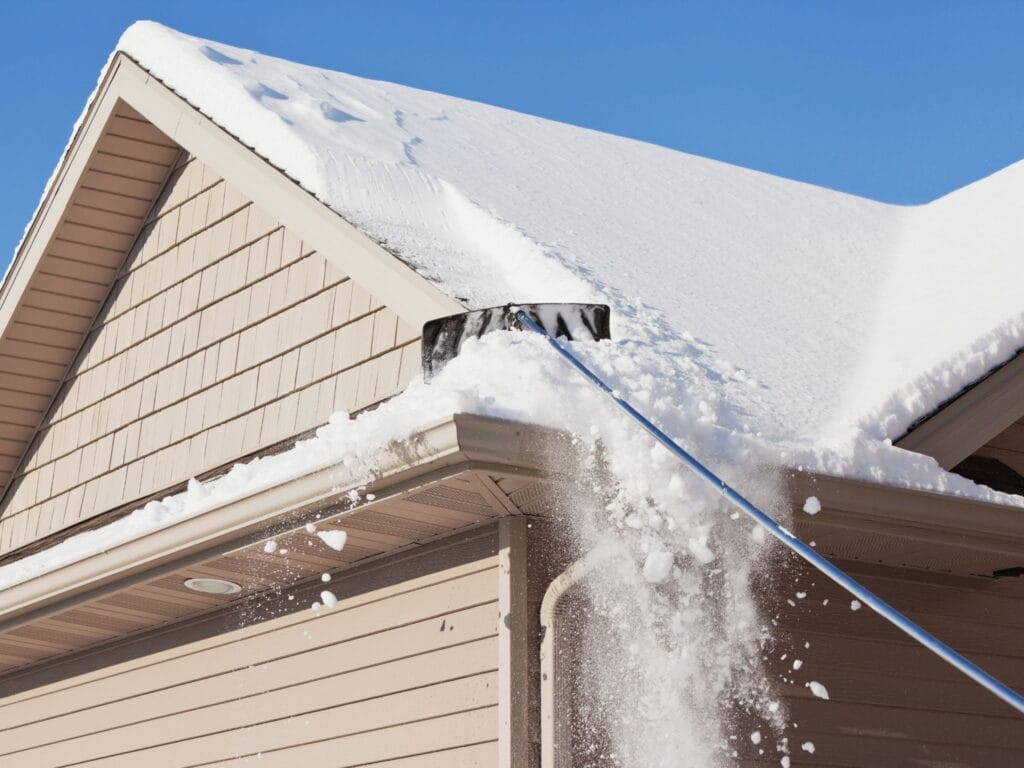
For single-story homes and accessible sections of two-story homes, a roof rake is a safer and practical ground-level snow removal option. A roof rake is an aluminum or plastic scraper on a long telescoping handle, typically extending to 16 to 24 feet, that allows you to pull snow off the lower sections of the roof while standing on the ground.
Work in sections, pulling the rake toward you in smooth strokes rather than pushing it upward. Avoid using a metal edge directly on shingles, as aluminum rake heads can gouge soft asphalt. Look for models with wheels, foam bumpers, or slide guides that keep the blade slightly above the surface. Remove snow from the bottom up, clearing the lower 3 to 4 feet of the roof first where ice dams are most likely to form. Do not attempt to remove all snow from the entire roof surface; clearing the lower edge can help reduce the risk of ice-dam buildup.
Stand clear of the area where snow will fall. Roof snow can slide off in large, dense slabs that cause injury if they land on a person standing directly below. Never stand on a ladder while using a roof rake, as the leverage and movement of the tool create an unstable situation.
Calcium Chloride Ice Melt
For ice dams that have already formed, calcium chloride ice melt can be an effective treatment when applied according to the manufacturer’s instructions. Use it carefully near metal flashing, gutters, and vegetation, as it can cause corrosion and affect surrounding plant material. Fill a mesh bag or tube sock with calcium chloride pellets and lay it across the ice dam perpendicular to the eave to create a drainage channel. Avoid rock salt near roofing materials, as it can accelerate corrosion on metal components and harm vegetation.
Do not chip at ice dams with hammers, chisels, or ice picks. Mechanical chipping of ice on a roof can easily damage the shingles or membrane beneath, and it does not address the formation mechanism.
When to Call a Professional
Certain situations require professional snow removal rather than a DIY approach. Any roof that cannot be adequately reached with a ground-level roof rake should be left to a crew with the proper safety equipment. Multi-story roofs, roofs with unusual pitch or configuration, and flat commercial roofs all fall into this category.
If ice dams have already caused an interior leak, the priority shifts from snow removal to leak containment and damage assessment. A qualified roofing contractor can evaluate the extent of damage to the roofing membrane, flashing, and underlying structure, and determine whether repairs are needed before the system is loaded again by the next storm. The roof repair and maintenance services available from an experienced contractor cover both emergency response and the preventive inspections that catch damage before it becomes a winter emergency.
Protecting Your Roof and Gutters Through Winter
Snow removal is only one part of keeping a roof healthy through an Ontario winter. Gutters and downspouts that are clear before the first freeze allow meltwater to drain efficiently rather than pooling and freezing. Downspout extensions that direct water away from the foundation can help reduce ice buildup at grade level that might otherwise affect basement drainage.
Gutters that are partially blocked with debris can worsen drainage and contribute to ice buildup at the eave, though uneven roof-surface temperature is the primary driver of ice-dam formation. Ensuring that the gutters and drainage components of your roof are clean and properly attached going into winter can reduce the risk of both ice dam formation and the gutter damage that comes from ice-weighted gutters pulling away from the fascia.
After a particularly heavy winter or a season with frequent ice dam events, a post-winter roof inspection is worth scheduling. Freeze-thaw damage to shingles, cracked or lifted flashing, and gaps at penetration points are easier to address in spring before they become leak sources during the summer rain season.
If you have experienced interior water infiltration during this past winter and want a professional assessment of the damage, contact the team to schedule an inspection at the start of the season.
Preventing Ice Dams Long-Term
Addressing ice dams by clearing snow each winter is a management approach. Reducing the conditions that create them addresses a common underlying cause. Heat loss from the living space into the attic is a frequent contributing factor, which warms the upper sections of the roof and initiates the melting cycle.
Improving attic floor insulation to current energy code standards reduces the amount of heat escaping into the attic space. Sealing air leaks around electrical boxes, plumbing penetrations, attic hatches, and anywhere else that conditioned air moves from the living space into the attic reduces the temperature differential between the upper and lower sections of the roof. These improvements also reduce heating costs, making them doubly worthwhile.
Checking the signs that your roof may need attention after a difficult winter helps you stay ahead of any deterioration that ongoing ice and water exposure may have caused.
Conclusion
Roof snow removal can be an important part of homeownership in Canada for those with flat or low-slope roof sections or a history of ice-dam formation. The key principles are straightforward: act before accumulation reaches dangerous levels, use ground-level tools whenever possible, avoid working on the roof surface in winter conditions, and follow product instructions when using ice-melting materials and avoid chipping at the ice mechanically. For any situation beyond what a roof rake can handle safely from the ground, consider hiring a qualified roofing contractor. Protecting the roof through winter may help reduce the need for repairs in spring and support a longer overall lifespan for the roofing system.
Frequently Asked Questions About Roof Snow Removal
How much snow is too much for a roof?
For flat or low-slope roofs, 8 to 12 inches of wet heavy snow warrants attention. For pitched residential roofs, the threshold is higher, and the concern shifts more toward ice dam formation at the eave than pure weight load. If you are unsure, a professional structural assessment may be appropriate.
Is it safe to get on my roof to remove snow?
In most cases, no. A snow-covered or icy roof presents a serious fall risk. Roof rakes can provide a safer option when used correctly from the ground for single-story and many two-story homes. For roofs that cannot be reached from the ground, hire a contractor with the proper safety equipment.
How do I stop ice dams from forming?
Improve attic insulation and seal air leaks between the living space and the attic. These steps reduce the heat loss that causes uneven roof surface temperatures. Clearing snow from the lower sections of the roof before freeze-thaw events occur also reduces the material available for ice dam formation.
Can ice dams damage my roof permanently?
Yes. Ice dams force water under shingles and flashing, saturating the underlayment and wood decking. Repeated cycles of this type of infiltration can cause rot in the decking and framing, mold in the insulation and attic, and deterioration of the shingles themselves. Addressing ice dam damage promptly in spring can help prevent long-term structural problems.